|
The first set of photos and the accompanying tying description is for a fly
that evolved from the popular elk hair caddis but which we've modified
slightly to acquire some characteristics that allow it to be used for a
variety of insects including the caddis and a variety of different types of stones plus a few mayflies. We named it the
"White River Special" or "WRS" for short.
The fly was first used on that river and proved to be successful
during a weekend when a many surface insects were on the water, including
several types of caddis, red quills, yellow sallies, and some larger
golden stones.
We all know there's really nothing much new under the sun, and this
imitation is no exception to that rule. Based roughly on an elk hair
caddis design, there are a few significant differences. The hook is
always a TMC 200R, and the tying thread is always fluorescent orange.
No hackle is used, nor is there any tail. Natural deer or elk wing
hair is preferred to any of those hairs dyed or bleached.
The only other modifications we make are to sometimes add rubber legs or a few strands of krystal flash built into
the wings as extra sparkle.
WRS and Rubber Leg WRS:

From upper left reading clockwise around the photo are a dark bodied,
black rubber leg, yellow bodied white rubber leg, krystal flash wing
model, and the fly as originally tied at the lower left.
We blend a variety of materials to create what sometimes become fairly
complex dubbings. Depending on the coloration desired, natural
hare's ear, hairtrons, antrons, and any number of other natural and
synthetic materials are combined in an effort to create a
"buggy" body that will emulate the movement of palmered body or
collar hackles.
Tying is extremely simple. Make a dubbing loop, insert dubbing,
and tie in the back two thirds of the hook, followed by the wing, and then
take two or three wraps of the dubbing over the base of the hair wing to
form a somewhat large "head" for the fly. If rubber legs
are added, they are tied on prior to wrapping the dubbing over the base of
the hair wing. That's all there is to it. A full range of hook
sizes from 12 through 22 can be utilized for different insect imitations.
Later version rubber leg WRS:
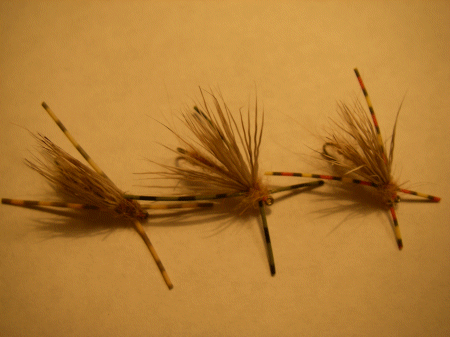 Here
are some of the most current rubber leg models that we began using in the
summer of 2008. Here
are some of the most current rubber leg models that we began using in the
summer of 2008.
All have been very effective at mimicking caddis, stones, cicada, and
various terrestrials.
From left to right, we have yellow banded legs, then olive/black
banded, and finally king snake color bands.
Body dubbing varies depending on the insect we wish to approximate.
Tying thread remains fluorescent orange and the hooks are still 200R's.
Spotlight addition to a rubber leg WRS:
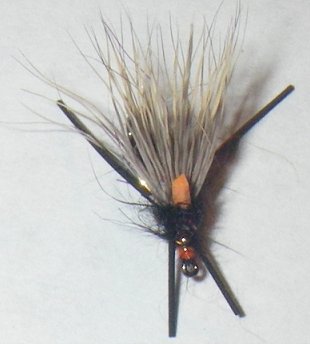
Not much changed here - simply the addition of a small chunk of
orange foam tied in front of the wings to make the fly more visible on
the water.
(Obviously also a big help to us whose eyes aren't quite as good as
they were a few years ago!)
Specific WRS modification as a yellow sallie:
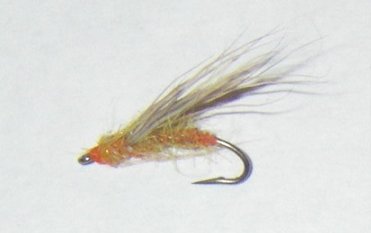 The
more conventional winged WRS wasn't working well when we encountered
yellow sallie hatches. The
more conventional winged WRS wasn't working well when we encountered
yellow sallie hatches.
Changes made to the fly shown here are much more effective.
An orange tag is tied at the rear of the body. The wing is
sparser and tied flatter over the body.
These slight modifications proved to be outstanding when fishing
this specific hatch on difficult streams like the Green below Flaming
Gorge and on the Frying Pan.
Tying Directions for the WRS fly:
Here are a set of photos that describe the tying technique for the
WRS. There are a couple of minor modifications to this version
compared to the way it was originally designed. Foremost would be
the addition of a small foam core to the body under the dubbing material.
The reason adding the foam is that roughly ninety percent of the time,
we are trailing a weighted nymph behind the surface fly. The foam
seems to give the WRS a bit better level of floatation compared to the
unfoamed version.
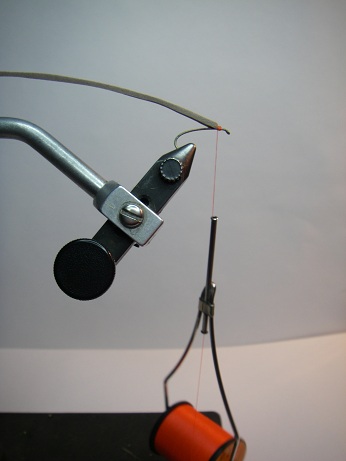 |
Thread is always fluorescent orange. 6/0 is used down to
size 18 on the 200R hook after debarbing the hook in the vise.
8/0 is used for smaller sizes.
In this photo we've cinched down a small piece of 2mm foam to the
head of the fly.
It's not necessary to have a foam core unless additional
flotation is desired.
|
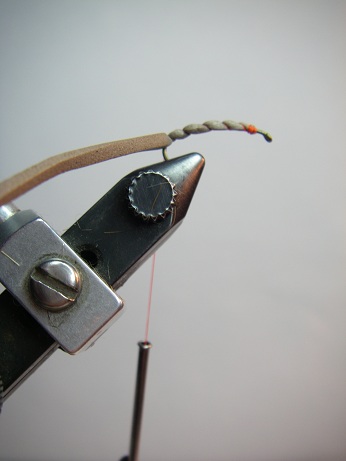 |
The core material is tied off towards the tail of the fly.
If even more flotation is desired, the remaining foam can be left
at the end of the hook and then drawn forward over the back of the
fly after the body is dubbed.
|
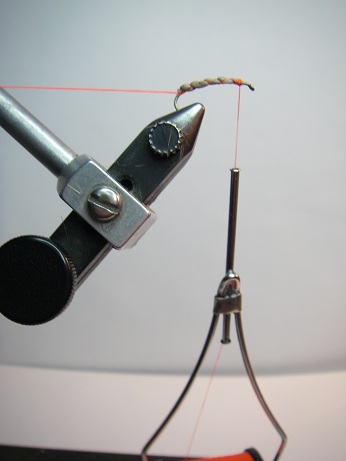 |
In this case the foam was clipped off, the dubbing loop created,
and the thread returned to the head of the fly. |
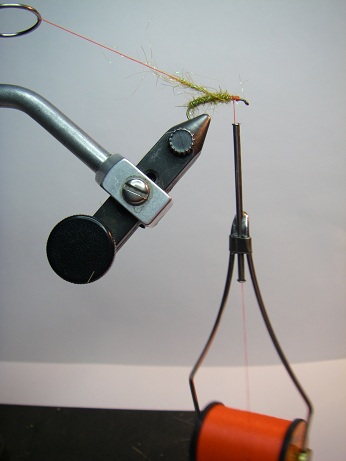 |
The body is dubbed towards the head, leaving a short space free to
tie in the hair wing material.
On this particular fly we've used yellow/green hare and ice
dubbing. |
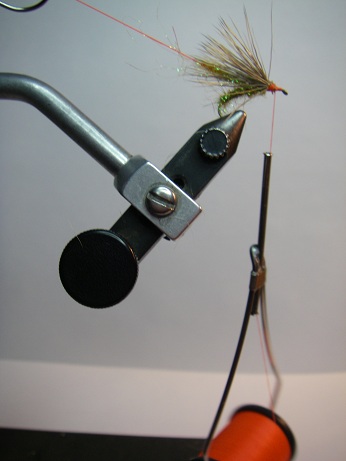 |
The hair wing is tied in next and heavily cinched down near the
head of the fly.
Natural elk or coastal deer seems to work far better and float
higher than does bleached or dyed hair.
Two or three loops of the dubbing are then tied over the thread
near the hook eye to form a somewhat larger head for the fly. |
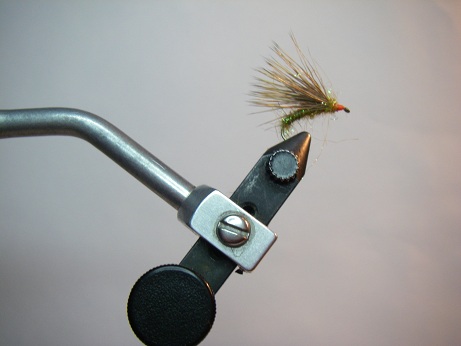
Here's the completed version. This might be the simplest
fly in the world to tie. |
The next set of photos is of a flat
water type cicada pattern we've developed specifically for that insect emergence on the Green River below Flaming
Gorge.
Green River Cicada:

Clockwise from upper left are a turkey winged black rubber leg, then
the same wing, but orange/black centipede legged model.
Bottom right is the same orange/black centipede leg fly, but with a
gray mottled medallion sheeting wing.
Bottom left is the same fly as previous, except with black legs.
Frankly these imitations are quite time consuming to construct.
Almost any standard dry fly hook will work. Our best success has
been using a TMC 200R is sizes 10-16 (see WRS above). The under body
dubbing is a blend of half black and half orange material.
The two mm. thickness black foam is tied in at the tail and is pulled
over the first half of the dubbing (starting at the top of the back bend
of the hook). The back rubber legs are then tied at that juncture.
Four strands of root beer colored krystal flash are tied over the legs and
then the wing material is tied in atop the krystal. (If a
section of wild turkey feather is used, a preliminary coating of flexament
will strengthen the wing.)
One or two wraps of the dubbing is tied over the same joint, and then
the dubbing is continued on towards the head beneath the next section of
foam. The foam is then tied down near the head with the last set of
double legs applied next. The balance of the foam material is pulled
back over the upper section of the body and is secured to create an
oversized head. Any excess foam is clipped off. While an extra
heavy thread is not needed to secure 2 mm. sized foam, we've used 3/0
anyway as the wider width thread tends to not cut the foam.
As might be expected, these flies are difficult to see on the water
since they ride low in the film. It's possible to tie on a
bright colored piece of extra foam material over the head, but as this fly
will sometimes land upside down on the stream, the artificiality of that
kind of colored addition might detract from the fly's appearance and
certainly would cause more refusals.
This fly design has produced outstanding results compared to the
commercially tied versions available at local Dutch John fly shops.
The model has been fished in tandem with those other styles and has been
found to draw several times more strikes than the more commonly available
bleached hair wing or strictly krystal flash wing styles.
Olive wing cicada:
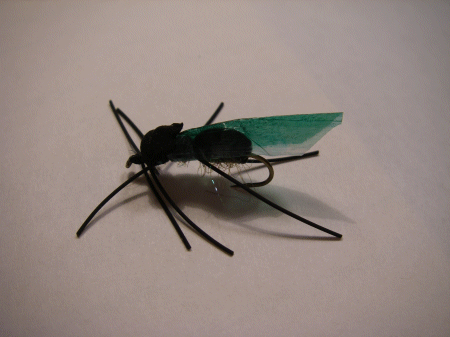 June,
2008. The fishing report for the Green below Flaming Gorge now
suggests that the regular cicada patterns have been cast so often by
floaters and bank fishers that more subtlety is needed. June,
2008. The fishing report for the Green below Flaming Gorge now
suggests that the regular cicada patterns have been cast so often by
floaters and bank fishers that more subtlety is needed.
Apparently the current emergence - as opposed to what we've seen in
previous years - have an olive sheen to them for whatever reason.
Here we've substituted solid black legs and a green tinged underbody
dubbing plus a peacock colored medallion sheeting for the wings.
Stick Fly:
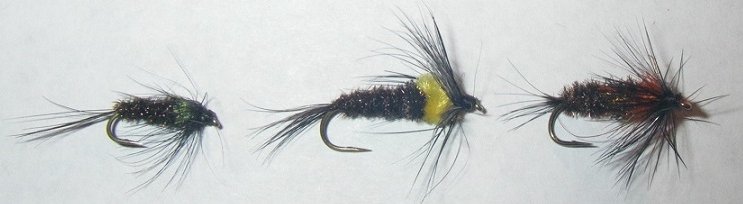
I've had a love/hate relationship with stonefly nymph imitations
over the years. Found them very complicated to tie successfully
and never seemed to have exactly what the fish were looking for when I
used them.
Don't know exactly where this heavily weighted impressionistic fly
came from, but I first saw it in Phillip White's book "Trout Fly
Tying". It seems to work as well for me as any of the other
stone or similar types of nymphs I've used before, so it's my fly of
choice when searching the bottom of streams (many times trailed by a
small scud or other smallish nymph.)
Simple to tie. Body and thorax are wound with .015 or .020
lead wire as an underbody. The body is peacock herl, and the
thorax is green, yellow, or burnt orange dubbing or chenille.
Only difference between this fly and the original I saw in the book is
the addition of a short tail of the same black hackle fibers.
Antenna Pupa:
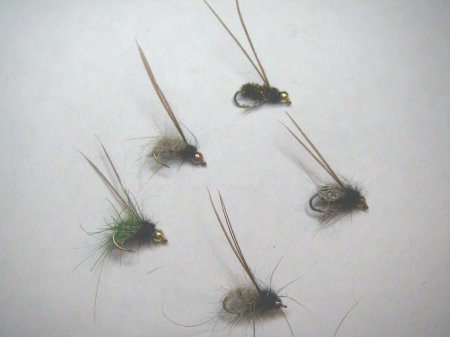 This
fly has become increasingly useful over the years. This
fly has become increasingly useful over the years.
Developed originally by a tier in the Salida, Colorado area, we've made
it our primary pupa pattern when caddis are in bloom.
My sense is that the antenna provide a wonderful sense of motion that
successful patterns of many insect types use to fool fish.
Some parts of the original stay the same. The two antenna remain
pheasant tail fibers. A bead usually is employed not only to get the
fly down in the flow but also to emulate the air bubbles that help a pupa
reach the surface although we use some completely unweighted.
Our modifications relate to body materials. Variations include
peacock herl wrapped around a copper wire (as in a dubbing brush),
sometimes overlaid with antron (ala Lafontaine). Other body changes
would be the use of gray or insect green Hare's Ear Plus dubbing.
Legs are always partridge. The thorax or head would generally be
black Hare's Ear Plus dubbing.
A year 2009 modification. We've eliminated the use of partridge
legs. Their loss doesn't seem to matter to the trout at all.
Serendipity Buckskin (Buckskindipity):
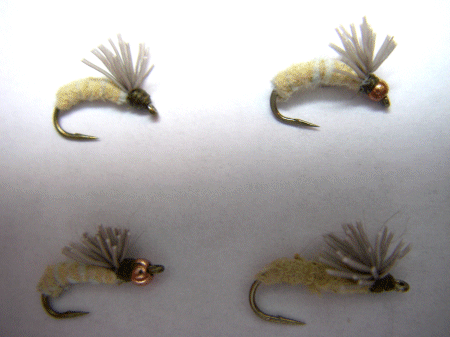
Here's another slight modification to an old pattern.
Again there's nothing original here - just the addition of a stub deer
or elk hair wing to the classic buckskin nymph.
We made this change in the summer of 2009, and it worked very
effectively on a number of streams - foremost being the Arkansas.
The leather body material quickly absorbs water and sinks
readily. The addition of a small bead may help with a bit of flash
though it hasn't been any more effective than the beadless model. Am
guessing the nymph represents a generic caddis emerger.
We've tied the fly on either a standard length straight nymph hook or
on a 2487-88 curved hook in sizes from 16-20.
Next. Here's another modification to a preexisting pattern known
as the RS-2. We found the original to be more or less always
effective, but it didn't seem to have enough "attractor" quality
to trigger takes in stream flow conditions that were somewhat off color.
Sparkle wing RS-2:
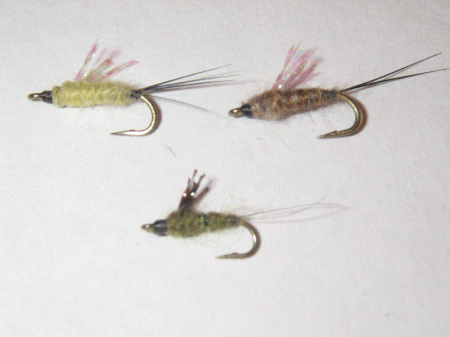 To
give the fly a bit more flash, the stub or emerging wing material was
changed from either CDC or some other natural feather to several strands
of Krystal Flash. To
give the fly a bit more flash, the stub or emerging wing material was
changed from either CDC or some other natural feather to several strands
of Krystal Flash.
For most body dubbing colors the standard pearlescent material seems to
work the best.
But to more closely match an emerging BWO, we will sometimes substitute
black Krystal Flash instead.
Hook sizes are generally small - in the #18-22 range. 18's
for a PMD model and smaller for general purpose use. Although we
fish the fly primarily as a trailer behind either a WRS or another larger
nymph, we have added a few wraps of thin lead wire underneath the dubbing
to get the fly down quicker.
We've visited the famous Pelican Lake in Utah several times in the
recent years. This shallow warm water reservoir is loaded with
perhaps the best population of very LARGE bluegills in the country and
many bass besides. Located just a couple dozen miles west and south
of Vernal off Highway 40, it is seriously under fished by most fly people.
Though we've always encountered a few casters there, for the most part,
visiting fisher people tend to turn north at Vernal and head to the more
famous tailwater below the Flaming Gorge dam. That's possibly a
mistake.
In a couple of hours of wading the reeds along any bank of the lake
it's possible to play and release up to three digit numbers of absolutely
wonderful fish. Eventually too much of that good thing becomes too
much, but it's still a whole bunch of fun as a prelude to fishing the
"Green".
Simple damsel nymph:
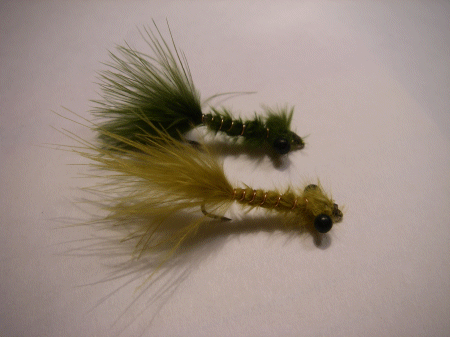 Here's
a fly that we experimented with and have found to be relentlessly
successful in the reeds despite whatever other hatch or emergence may be
occurring. Here's
a fly that we experimented with and have found to be relentlessly
successful in the reeds despite whatever other hatch or emergence may be
occurring.
It's nothing more than a very simple rendition of a damsel fly nymph.
Tied on a 3X long #12 streamer hook, it's unweighted. The eyes are
black plastic barbells.
A marabou plume is tied in at the back end of the hook and then wrapped
forward around the hook to create the body.
The marabou continues towards the head to be over wrapped a couple of
times over & under the eyes to give that head some detail. A
medium sized copper wire is wrapped from the tail to the head to create
segmentation. We assume the color should match the color of the
indigenous damsels, but here at Pelican, gold seems to work a bit better
than either olive or darker green.
We fish it just at the depth it sinks to when cast with a floating line
and twitch it back. Not retrieving with a twitch risks the loss of
many fish as these bluegills tend to "taste" a fly before taking
it. The twitch allows the fisher to feel the bite.
The balance of the patterns shown below
have been added to this page from time to time since 1997. They're
shown in the chronological order that they were added. Those at the
end of this list are the most recently constructed.
Complex dubbings are now being created
that incorporate the "legginess" hackle feathers normally confer
on an artificial, and the hackle feather flotation qualities are now being
generated by waterproofing the fly at the time it comes out of the vise.
Here are a few patterns that have been
extremely successful locally - where appropriate the comments in blue type
face reflect current thinking about body & winging materials.
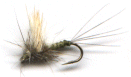 Blue
Winged Olive Variation: While our tying philosophy
continues to be to simplify & minimize materials used in construction,
this particular version of a Blue Winged Olive comparadun benefits from a
bit more complexity. Since our local BWO's are fairly small, we use
standard #18-22 dry fly hooks. Blue
Winged Olive Variation: While our tying philosophy
continues to be to simplify & minimize materials used in construction,
this particular version of a Blue Winged Olive comparadun benefits from a
bit more complexity. Since our local BWO's are fairly small, we use
standard #18-22 dry fly hooks.
The tail is a few dark dun hackle fibers.
Body is BWO colored quill. Wings are light or gray colored elk or
deer hair tied comparadun style. The thorax region is dubbed
with a combination of regular hare's mask fibers into which has been
blended a small amount of BWO colored micro dubbing. This style
thorax is much more realistic in appearance than is created by the use of
standard BWO dubbing without the hare's ear fibers, and it is the key to
the construction of this fly.
 Generic
Midge Emerger: This is another very simple pattern used
primarily during late fall through early spring when the only hatches we
see on Generic
Midge Emerger: This is another very simple pattern used
primarily during late fall through early spring when the only hatches we
see on  some
of our more fishable winter tailwaters are a variety of different
colored midges. It's tied either on straight or curved nymph hooks
(as shown here) generally between sizes 18-22. some
of our more fishable winter tailwaters are a variety of different
colored midges. It's tied either on straight or curved nymph hooks
(as shown here) generally between sizes 18-22.
Note that a few turns of thin lead wire can be wrapped around the body
region to sink the fly without the need for split shot. The body is
either black or white krystal flash. A few short light dun CDC
fibers makeup the vestigial wing. The thorax is a few wraps of
peacock herl. The CDC wing offers the possibility of fishing the fly
in the film if desired, although generally this imitation will be fished
it mid flow or towards the bottom.
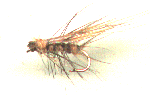 Hybrid
Caddis: It probably appears heavily dressed in this scan, but
is not. In fact sparseness is it's redeeming grace. Sizes range from
#10-20. Materials are as follows: No tail, cinnamon caddis dubbing body,
dark dun body hackle (not palmered), wing is sparse (not stacked) elk hock
hair. Hybrid
Caddis: It probably appears heavily dressed in this scan, but
is not. In fact sparseness is it's redeeming grace. Sizes range from
#10-20. Materials are as follows: No tail, cinnamon caddis dubbing body,
dark dun body hackle (not palmered), wing is sparse (not stacked) elk hock
hair.
This fly is best tied very lightly. It
imitates not only the local dominant caddis coloration extremely
successfully, but also those on the Roaring Fork, Gunnison, Deschutes
& McKenzie & Umpqua (Oregon). The hybrid name comes from the fact
(primarily due to unstacked wing hair) that it also successfully imitates
several local May fly variations. (Beginning in
1999, we built the bodies strictly with complex colored dubbings,
eliminating the palmered body hackle. Dubbing colors are
blended to suit the local situation. Materials include various
antrons, natural rabbit fur with guard hairs, and a base of hareline or
superfine standard dubbing.)
Normally it's fished as part of a double
fly rig - generally with a darker green bodied version with dark wings -
sometimes with an emerger or appropriate bead head.
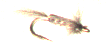 Gray
Midge Emerger: This spring the pattern was the most
successful of all larval, emerger, or surface midges we used on Gore Creek
and the Eagle. Not an original. It comes from the book of Western Hatches
by Hafele & Hughes. (See page 194). It's described as an emerging
pupa. Gray
Midge Emerger: This spring the pattern was the most
successful of all larval, emerger, or surface midges we used on Gore Creek
and the Eagle. Not an original. It comes from the book of Western Hatches
by Hafele & Hughes. (See page 194). It's described as an emerging
pupa.
We tie it locally exactly as described in
the book. Sizes 18-24. Tail is ostrich herl, body is deer hair ribbed with
ultrafine gold wire. Thorax is narrow gray ostrich herl. The fly was
fabulous during the spring of 1997.
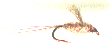 OS-1: A knock-off of an RS-2. The scan is not good
colorwise, but a few dark dun hackle feathers are used for the tail, a
torpedo shaped gray dubbed body and a stubby stack of grey partridge
feathers emerging from the body two thirds towards the head. Tied on
standard length wet fly hooks in sizes from 16-22.
OS-1: A knock-off of an RS-2. The scan is not good
colorwise, but a few dark dun hackle feathers are used for the tail, a
torpedo shaped gray dubbed body and a stubby stack of grey partridge
feathers emerging from the body two thirds towards the head. Tied on
standard length wet fly hooks in sizes from 16-22.
(The BWO pattern uses
olive partridge. Starting in 1999, wing stubs have all be various
shades of CDC depending on the type of insect being matched. This
allows the emerger to be fished nicely in the film as well as deeper.)
This has been an outstanding nymph/emerger
on Gore Creek and the Eagle in the past few years.
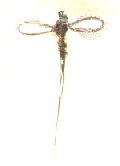 Spent Wing May Fly: Not an original pattern, but one
that was enormously successful in 1996. Tied in all color variations to
imitate baetis, red quill, blue quill, green drake, etc. Sizes from 10-22.
Spent Wing May Fly: Not an original pattern, but one
that was enormously successful in 1996. Tied in all color variations to
imitate baetis, red quill, blue quill, green drake, etc. Sizes from 10-22.
Tail feathers to match the natural and
body dubbing appropriate for standard may fly patterns. The wing obviously
is formed from a hackle feather that has been trimmed very close to the
quill. It's then tied in a figure eight over the thorax area. Hackle can
be non-existent, dubbing based, parachute, or standard wrap. This type of
tie can also be used for tricos in appropriate sizes and colors.
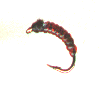 Red Midge: Another very successful Gore Creek fly
this spring (1998). Used in small sizes - either standard length straight
wet fly hook or as shown here in a curved style (2487 or 2488). Sizes were
#18-22, although larger 2X-4X long hooks in #10-16 would work as bloodworm
larva in lakes.
Red Midge: Another very successful Gore Creek fly
this spring (1998). Used in small sizes - either standard length straight
wet fly hook or as shown here in a curved style (2487 or 2488). Sizes were
#18-22, although larger 2X-4X long hooks in #10-16 would work as bloodworm
larva in lakes.
No tail - or a few partridge feathers.
Body is micro sized red v-rib. 8-0 Black thread for a head, and there is a
barely visible vestigial wing pad of antron or other bright material just
behind the head.
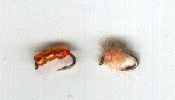 Egg
Flies: The left one is a simple glass bead fly. Number of
segments are dependent on the hook size. Right fly is a crosscut
scintilla. The left one is more original and some days is superior to the
scintilla, but on balance the scintilla would be preferred. Egg
Flies: The left one is a simple glass bead fly. Number of
segments are dependent on the hook size. Right fly is a crosscut
scintilla. The left one is more original and some days is superior to the
scintilla, but on balance the scintilla would be preferred.
Tie the glass bead by over wrapping the
hook with florescent orange thread. Slip on the beads and tie the thread
off at the bend of the hook. A drop or two of super glue secures the
package.
For the scintilla model create a dubbing
loop of 6/0 or 8/0 orange thread and fill it with amber or similar shade
of scintilla. Keep the dubbing sparse and before wrapping, cut it close to
the thread. Wrap the fly with figure eight motions. This pattern is
incredibly lifelike when wet. The "yolk" is astonishingly
realistic.
 Light Yellow Stone: Despite it's benign appearance
this was probably the most successful fly of the 1999 season through
mid-August. It was developed to roughly simulate the many small
yellow stones we locally encounter on the Eagle and Roaring Fork Rivers.
Light Yellow Stone: Despite it's benign appearance
this was probably the most successful fly of the 1999 season through
mid-August. It was developed to roughly simulate the many small
yellow stones we locally encounter on the Eagle and Roaring Fork Rivers.
Tied in sizes 14-20 on 2X long dry fly
hooks, use a PMD blend body dubbing material. The full length
forward tied hackle is either brown or light dun. Wing can be
various shades of bucktail or elk hair. Best color this season was
pure white. Start the dubbing, then tie in the wing. Overlay
the wing with a few wraps of dubbing to the head, and then tie in the
hackle starting at the tail of the fly forward all the way to the head in
stimulator fashion. Smaller sizes (16-20) seem to be the most
useful. (Again beginning in 1999, the
body is strictly complex dubbing material. The fly is astonishingly
versatile. We've successfully used it to imitate a variety of
yellow, green, and golden stones, as well as green drakes and
grasshoppers. Obviously it's tied in larger sizes to match these
other insects.)
 Dark
Stone Nymph A generic stone we tie on 2-3X long
nymph hooks in sizes from 10-20. This may be the best all
around local nymph pattern - superior to prince's and other more realistic
stones. Dark
Stone Nymph A generic stone we tie on 2-3X long
nymph hooks in sizes from 10-20. This may be the best all
around local nymph pattern - superior to prince's and other more realistic
stones.
Use brown thread. Tails are dark brown or black goose biots.
Body is the most interesting feature. Make up a peacock herl dubbing
brush on the spot. Depending on the size of the fly, tie in butt
first 2-4 pieces of herl; then tie in a piece of fine copper wire
same length as the herl. With a hackle plier gently wind those part
together and begin wrapping on the body. Towards the thorax the
brush can be lapped back & forth to add mass to that section.
Tie in appropriate sized black hackle at the head and take 3-4 wraps.
Pull a previously tied in dark turkey flat section over the top of the
hackle & tie in at the head. Do not overdress any part of
this fly.
 Yellow/Golden
Stone Similar to the above, but tied with brown biots, brown
turkey flat wing pads and light brown hackle. Again with or without
a gold or other colored bead head. Only difference is body
preparation and that can be any light olive or PMD colored dubbing.
I usually run a section of yellow flashabou from the tail to the head for
segmentation and sparkle. Sizes as above. Again, do not
overdress. Yellow/Golden
Stone Similar to the above, but tied with brown biots, brown
turkey flat wing pads and light brown hackle. Again with or without
a gold or other colored bead head. Only difference is body
preparation and that can be any light olive or PMD colored dubbing.
I usually run a section of yellow flashabou from the tail to the head for
segmentation and sparkle. Sizes as above. Again, do not
overdress.
 Caddis
Emerger This is really just an adaptation of a
Lafontaine caddis. Here we seem to have better luck below the
surface during the blizzard-like spring caddis hatches. So this fly
is generally used with a small gold bead head. We use various colors
of antron for the shuck, sometimes trailing the fly, sometimes just
covering it. For a body simply use appropriate wraps of peacock
herl. Partridge in different shades makes the wing. Caddis
Emerger This is really just an adaptation of a
Lafontaine caddis. Here we seem to have better luck below the
surface during the blizzard-like spring caddis hatches. So this fly
is generally used with a small gold bead head. We use various colors
of antron for the shuck, sometimes trailing the fly, sometimes just
covering it. For a body simply use appropriate wraps of peacock
herl. Partridge in different shades makes the wing.
  Rabbit Bugger A variation on the
conventional wooly bugger. Since our personal tying philosophy is
moving away from the use of hackles, this construction seems to work well
in terms of the way the body moves and pulsates in the water. The
image on the left is that of the bugger when dry & the one on the
right is after it's wet.
Rabbit Bugger A variation on the
conventional wooly bugger. Since our personal tying philosophy is
moving away from the use of hackles, this construction seems to work well
in terms of the way the body moves and pulsates in the water. The
image on the left is that of the bugger when dry & the one on the
right is after it's wet.
Use any desired type of weighting device - from the painted lead eyes
noted here to other metal eyes, cone heads or bead heads. The tail
is a clump of any colored marabou with a few strands of appropriately
colored krystal flash of the same length. The body is simply regular
rabbit fur cut from the skin strips & placed in a dubbing loop much
like any other dubbing would be used. Continue the dubbing up and
over the eyes to create a fuller head. Sizes range from 6-14 on 3X
or 4X long streamer hooks.
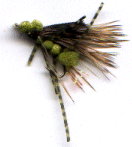 Gunnison
Hopper Synthesized from a number of other hopper
imitations. Body is yellow foam colored with an olive prisma pen.
Legs are any mottled green rubber leg material. Under wing is
natural elk body hair and over wing is a tent folded section of turkey
feather. Coloration is a decent general match of the grasshoppers
common here in Colorado. Gunnison
Hopper Synthesized from a number of other hopper
imitations. Body is yellow foam colored with an olive prisma pen.
Legs are any mottled green rubber leg material. Under wing is
natural elk body hair and over wing is a tent folded section of turkey
feather. Coloration is a decent general match of the grasshoppers
common here in Colorado.
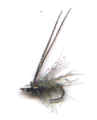 Caddis
Pupa This pattern showed up in one of the major fly
fishing publications this spring (2003). Developed by a guide from
the Salida area we modified it slightly but kept it mainly intact. #
16 standard length dry fly or nymph hook with 3/32 bead head in a variety
of colors. After body is dubbed tan or brown hare's ear, sometimes
simply peacock herl, followed by a few turns of partridge and a sparkly
dark dubbed thorax. Antenna are two pheasant tail feathers. Caddis
Pupa This pattern showed up in one of the major fly
fishing publications this spring (2003). Developed by a guide from
the Salida area we modified it slightly but kept it mainly intact. #
16 standard length dry fly or nymph hook with 3/32 bead head in a variety
of colors. After body is dubbed tan or brown hare's ear, sometimes
simply peacock herl, followed by a few turns of partridge and a sparkly
dark dubbed thorax. Antenna are two pheasant tail feathers.
As an option, we'll sometimes tie in a swath of antron
fibers behind the head and loop them back around the rear of the body
along the line of a Lafontaine emerging pupa.
|